CANDDIS - Monthly Crime Incident System
It has long been recognised that problems associated with crime and disorder, cannot be successfully tackled by individual effort of the Police or any other single agency. The Morgan Report (Home Office, 1991) makes the case for a holistic approach and introduced the concept of 'community safety'. It advocated the introduction a Multi-agency approach to crime reduction. Also, it suggested that local authorities and the police should be given a statutory duty to develop community safety using the multi agency approach.
During 1990's there was a wide scale voluntary development of community safety partnerships across the country. This process was formalised by DETR and the Home Office who provided funding for two Safer Cities programmes in the 1990's.
The desire to build upon Safer Cities, support voluntary partnerships and implement the Morgan Report was reflected is Sections 5 and 6 of the Crime and Disorder Act (CDA), 1998. A statutory duty was place upon Local Authorities, the Police, Health Authorities, Police Authorities and Probation Committees to work together and tackle problems of crime and disorder in their local areas. Further to that requirement, Section 6 stipulated that each partnership was to produce and publish a strategy to reduce these problems. The strategy should be based upon evidence gathered from findings from local consultation and a local audit.
As a part of the audit process agencies are required to share data. Sharing data allows the audit process to study trends and local areas, which results in high level policies and strategies to tackle locally identified needs.
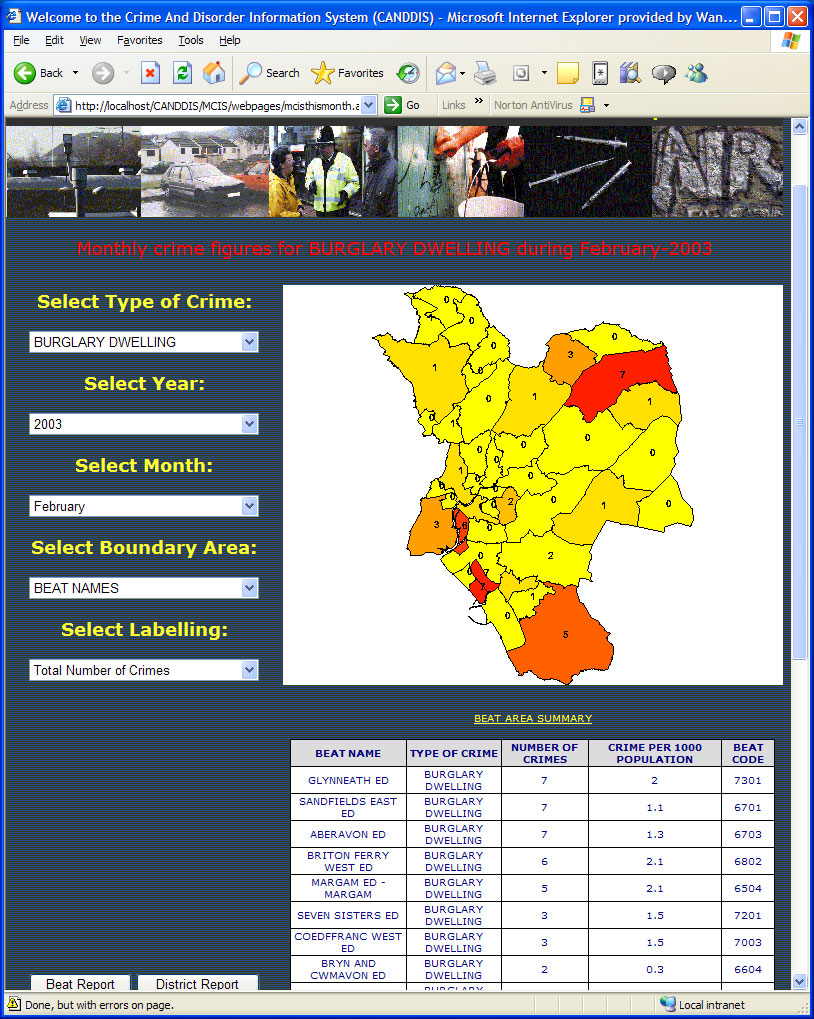
The Monthly Crime Incident Statistics system provides a tool in that process. By using a map interface data can be aggregated from random point data into meaningful depersonalised information. Senior managers and policy makers can use this information which provides a high level view of crime & disorder across a wide area. The Monthly Crime Incident Statistics is aimed at awareness rising and helps senior managers better understand crime and disorder. Providing a better understanding of crime and disorder allows policy makers to better target their strategies and implement action plans for reducing crime in a region.
| Features |
Benefits |
 |
Displays aggregated incident statistics. |
|
|
Aggregated statistics are easier to understand and make sense of. |
|
Aggregated statistics are de-personalised and are thus not subject to the same rigors of the Data Protection Act. |
|
Generalises crime for a division (beat, district or sector), allowing for an evidence-based interventions. |
|
|
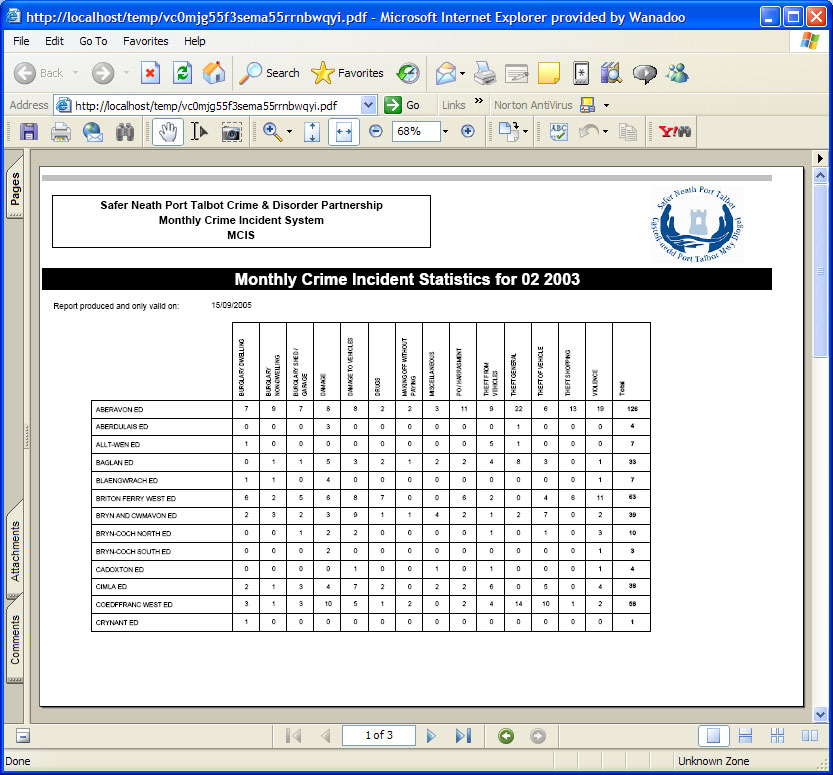
Produce statistical reports online |
|
|
Easy to read and professionally styled reports outputs crime statistics for geographic areas. |
|
Focus on the crimes relevant to the user. |
|
|
Graph Tools |
|
|
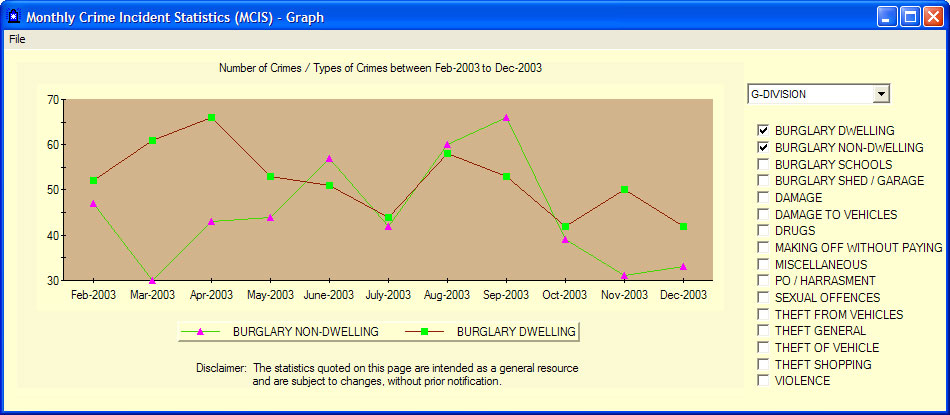
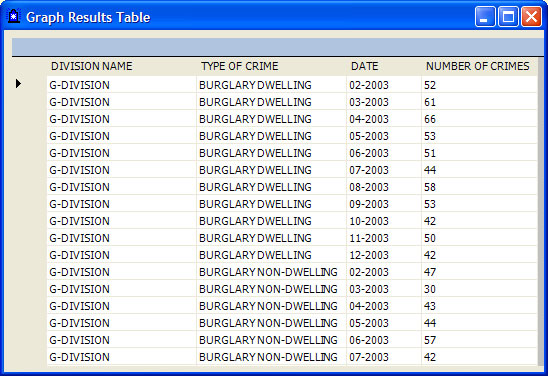
Trends are easy to spot with the embedded and easy to use graph tools. |
|
Include trend graphs in the local audit. |
|
|
Stunningly easy to use and understand |
|
|
No training is required to use this system. |
|
Local councillors are able to look-up the monthly figures for the Ward. |
|
|
Intra/Internet Interface |
|
|
Data can be easily shared with partner agencies. |
|
Can be delivered as a public awareness tool. |
|
Data is available to an unlimited amount of users. |
|